
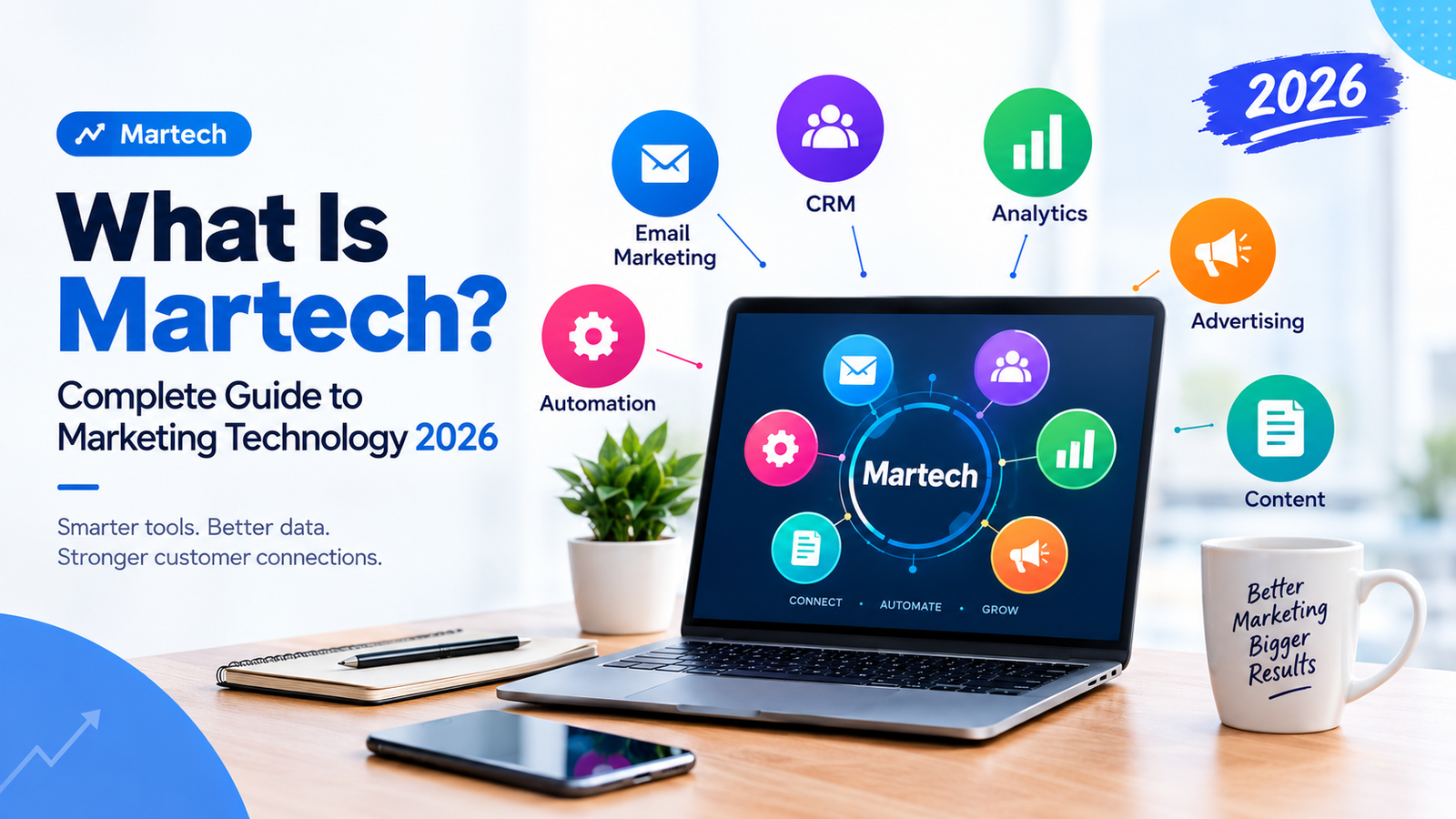
What Is Martech? Complete Guide to Marketing Technology 2026
Marketing has changed dramatically as businesses move from traditional campaigns to data-driven digital experiences. Martech, short for marketing technology, brings software, platforms, automation, analytics, and artificial intelligence together to help marketers attract, engage, convert, and retain customers. In 2026, understanding this technology is no longer limited to large enterprises. Small businesses, agencies, ecommerce brands, and growing companies can all use modern marketing tools to work more efficiently and make better decisions.
What Is Martech?
Martech refers to the collection of technologies marketers use to plan, execute, measure, and improve marketing activities. Instead of relying on disconnected spreadsheets and manual processes, companies can use integrated platforms to manage customer data, email campaigns, social media, advertising, content, analytics, and customer journeys.
The purpose is not simply to add more software to a business. A strong technology strategy connects useful tools so marketing teams can understand their audiences and deliver relevant experiences at the right time.
In 2026, artificial intelligence is becoming an increasingly important part of these platforms. AI can help analyze large amounts of customer data, identify patterns, personalize content, predict behavior, and automate repetitive marketing tasks.
Why Martech Matters in 2026
Customer expectations continue to rise. People want brands to provide useful information, quick responses, personalized experiences, and consistent communication across different channels.
Businesses therefore need technology that can help them manage increasingly complex customer journeys. A modern marketing system can bring information from websites, email campaigns, advertising platforms, social networks, and customer relationship systems into a more organized workflow.
The major value comes from combining efficiency, personalization, measurement, and automation.
| Marketing Need | Technology Solution | Main Benefit |
|---|---|---|
| Customer management | CRM platforms | Better customer relationships |
| Email campaigns | Email marketing software | Automated communication |
| Website measurement | Analytics platforms | Performance insights |
| Content creation | AI and content tools | Faster production |
| Advertising | Ad management platforms | Improved campaign control |
| Customer journeys | Automation platforms | Consistent engagement |
These capabilities allow teams to spend less time handling repetitive work and more time developing creative strategies.
Key Components of a Modern Martech Stack
A marketing stack is the collection of tools a company uses to support its marketing operations. Every organization has different requirements, so there is no single perfect stack.
Customer Relationship Management
CRM software helps businesses organize customer and prospect information. Marketing teams can use customer profiles to understand interactions, segment audiences, and coordinate campaigns with sales teams.
A CRM can become especially valuable when a company has a large number of prospects or repeat customers.
Marketing Automation
Marketing automation allows businesses to create workflows that run automatically according to customer actions or predefined conditions.
For example, when someone subscribes to a newsletter, an automated workflow might send a welcome email followed by educational content. This reduces manual work while maintaining regular communication.
Analytics and Reporting
Analytics tools help marketers understand what happens after a campaign launches. They can reveal information about website visits, conversions, engagement, traffic sources, and customer behavior.
The important point is not simply collecting data. Successful teams turn that information into decisions.
Content and Creative Technology
Modern marketers use technology to create, organize, distribute, and optimize content. AI-powered tools can support brainstorming, editing, personalization, research, and content workflows.
Human creativity remains important because technology can accelerate production, but strategy and brand understanding still require human judgment.
Advertising Technology
Advertising platforms help businesses manage paid campaigns across search engines, social networks, websites, and other digital channels. These systems can assist with audience targeting, budgeting, creative testing, and performance measurement.
How AI Is Transforming Martech
Artificial intelligence is one of the biggest developments shaping marketing technology in 2026. Instead of using AI only for content generation, businesses are increasingly applying it to analysis, prediction, personalization, and workflow automation.
AI can examine customer behavior and identify patterns that may be difficult for humans to recognize manually. It can also help marketers determine which audiences are more likely to respond to specific messages.
Another important development is generative AI. Marketing teams can use it to create initial drafts, campaign ideas, product descriptions, social media concepts, and other marketing materials.
However, AI-generated output should be reviewed before publication. Brand voice, accuracy, originality, privacy, and factual quality still require human oversight.
Benefits of Martech for Businesses
The right technology can provide several practical advantages.
Better Marketing Efficiency
Automation reduces the amount of repetitive work marketers need to perform manually. Scheduling campaigns, organizing customer information, reporting results, and managing workflows can become significantly more efficient.
More Personalized Experiences
Customers respond differently to different messages. Technology allows marketers to segment audiences based on interests, behaviors, interactions, or other relevant information.
This can make communication more useful instead of sending identical messages to everyone.
Stronger Decision-Making
Reliable data gives marketing teams a clearer picture of campaign performance. Instead of depending entirely on assumptions, marketers can use measurable results to identify what is working and where improvements are needed.
Improved Customer Journeys
Modern customers may interact with a company through multiple channels before making a decision. Connected systems can help businesses create a more consistent journey across websites, email, advertising, social media, and other touchpoints.
Challenges Businesses Should Consider
More technology does not automatically produce better marketing. Businesses can encounter problems when they purchase too many platforms without a clear strategy.
One common issue is tool fragmentation. If systems do not communicate effectively, customer information can become scattered across multiple platforms.
Another concern is data privacy. Companies must handle customer information responsibly and follow applicable privacy requirements. Security should be considered when selecting vendors and designing marketing workflows.
Cost is another factor. Subscription fees, implementation expenses, employee training, and maintenance can add up quickly.
For these reasons, companies should select technology based on actual business needs rather than following every new trend.
How to Build a Better Martech Stack
Building a useful stack starts with understanding the marketing process.
First, identify the biggest problems facing the team. Are marketers struggling with customer data, campaign reporting, lead management, content production, or automation?
Next, establish measurable goals. A company might want to increase qualified leads, improve customer retention, reduce manual work, or improve campaign attribution.
After defining goals, evaluate tools according to integration capabilities, usability, scalability, security, cost, and reporting features.
A simple approach can be summarized as follows:
Business goals → Marketing processes → Required capabilities → Tool selection → Integration → Measurement → Optimization
This approach prevents businesses from collecting unnecessary software and encourages them to build a stack around outcomes.
Martech Trends to Watch in 2026
The marketing technology landscape continues to evolve quickly. Several developments are particularly important this year.
AI-powered personalization is becoming more sophisticated, allowing brands to tailor experiences based on customer behavior and preferences.
Predictive analytics is helping marketers anticipate potential customer actions instead of only analyzing historical performance.
First-party data strategies are gaining importance as businesses seek greater control over customer information and data relationships.
Unified customer experiences are also becoming a priority. Customers expect brands to recognize their interactions across multiple channels.
Finally, AI-assisted marketing operations are reducing repetitive administrative work and allowing teams to focus more heavily on strategy and creative decisions.
Key Takeaways
The most important points to remember are:
- Martech connects technology with modern marketing activities.
- A strong marketing stack should support specific business objectives.
- AI is expanding automation, personalization, and analytical capabilities.
- CRM, automation, analytics, advertising, and content tools are major components.
- Too many disconnected platforms can create unnecessary complexity.
- Data privacy and security should remain priorities.
- Human strategy and oversight are still essential.
- Businesses should measure technology based on real marketing outcomes.
The Future of Martech
Marketing technology is moving toward greater integration, automation, and intelligence. As AI becomes more capable, marketers will have access to faster analysis and more sophisticated tools for creating customer experiences.
However, the future will not simply be about adopting the newest software. Successful businesses will focus on connecting technology with customer needs and measurable objectives.
The strongest teams will likely combine automation with human creativity. Technology can process information, identify patterns, and handle repetitive workflows, while marketers provide context, empathy, strategic thinking, and brand direction.
In 2026, the goal is therefore not to use the most tools. It is to build a practical technology ecosystem that helps a business understand its customers, communicate effectively, and improve continuously.
Conclusion
Martech has become a central part of modern digital marketing. From CRM and automation to analytics, advertising, content creation, and AI, technology gives businesses powerful ways to manage increasingly complex customer relationships.
The most effective approach is to start with business goals, identify genuine marketing challenges, and select tools that solve those problems. When platforms are integrated thoughtfully and supported by human expertise, marketing technology can improve efficiency, personalization, measurement, and customer experiences.
For businesses preparing for the future, 2026 is an opportunity to make their marketing systems smarter without making them unnecessarily complicated.
editor's pick
latest video

news via inbox
Nulla turp dis cursus. Integer liberos euismod pretium faucibua