How AI-Powered Smart Recipes Are Reshaping the Way Commercial Kitchens Operate – Copy
How AI-Powered Smart Recipes Are Reshaping the Way Commercial Kitchens Operate is becoming an important topic in the modern food service industry. Restaurants, hotels, catering companies, and institutional kitchens face growing pressure to prepare meals quickly while maintaining quality, controlling costs, and satisfying customers. Traditional kitchen management often relies on manual calculations, printed recipes, and the experience of individual chefs. Although these methods remain valuable, they can make it difficult to maintain consistency during busy service hours.
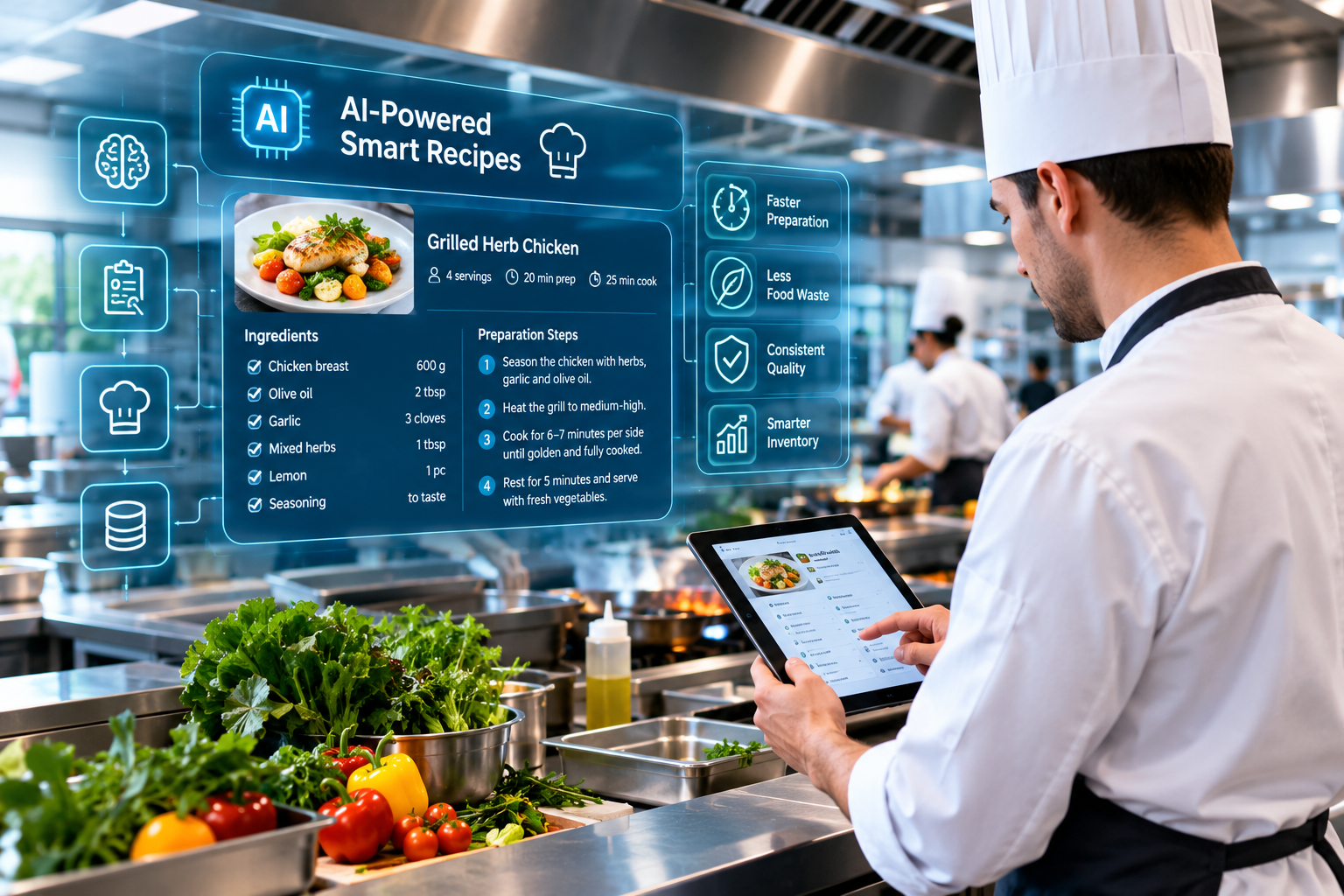
Artificial intelligence is introducing new possibilities through smart recipe platforms that analyze ingredients, portion sizes, preparation schedules, inventory levels, and customer preferences. These systems help kitchen teams make informed decisions and organize their work more efficiently. Rather than replacing professional chefs, smart recipe technology supports their expertise with useful information and automation. As commercial kitchens continue to adopt digital tools, AI-powered recipes are becoming a practical way to improve productivity and create a more organized working environment.
Understanding AI-Powered Smart Recipes
AI-powered smart recipes are digital cooking instructions enhanced by artificial intelligence, data analysis, and automated recommendations. Unlike traditional recipes that provide fixed ingredient quantities and preparation steps, intelligent systems can adapt instructions to changing kitchen requirements.
For example, a restaurant preparing lunch for 200 customers may need to adjust ingredient quantities, coordinate preparation times, and account for available stock. A smart recipe platform can calculate the required quantities, identify potential shortages, and provide standardized instructions for kitchen employees.
Some advanced platforms can also connect recipe information with inventory software, purchasing systems, nutrition databases, and kitchen management tools. This creates a more connected workflow, allowing managers and chefs to make decisions using current operational information.
However, the capabilities of these platforms vary. Their recommendations depend on the quality of the information provided, the software’s features, and the level of human oversight.
Why Commercial Kitchens Need Smarter Recipe Management
Commercial kitchens operate under constant pressure. Orders arrive quickly, ingredients must be available when needed, and dishes must meet established quality standards. Even small mistakes can cause delays, unnecessary spending, and customer dissatisfaction.
Traditional recipe management can become complicated when menus change frequently or several employees prepare the same dish. Different interpretations of ingredient quantities, cooking instructions, or portion sizes may lead to inconsistent results.
Smart recipe technology addresses these challenges by centralizing cooking instructions and supporting standardized procedures. Employees can access updated recipes, review preparation requirements, and follow consistent measurements.
For managers, this information also improves visibility into kitchen operations. They can identify recurring ingredient shortages, review preparation bottlenecks, and determine which recipes require adjustments.
The result is a more structured approach to food preparation, where decisions are guided by both culinary experience and reliable operational data.
How AI-Powered Smart Recipes Improve Kitchen Efficiency
Automated Ingredient Scaling
Preparing food for different numbers of customers requires accurate ingredient calculations. A recipe designed for ten servings may need substantial adjustments when a kitchen prepares hundreds of portions.
AI-supported recipe systems can scale ingredient quantities according to the required serving size. They may also account for available ingredient quantities, approved substitutions, and production requirements.
This reduces repetitive calculations and helps employees prepare large batches more consistently. Chefs can spend less time adjusting measurements manually and more time supervising cooking quality.
Nevertheless, ingredient scaling must consider more than simple multiplication. Cooking times, equipment capacity, seasoning, and certain ingredient ratios may change when recipes are prepared in larger quantities. Experienced chefs should review these adjustments before service.
Faster Preparation and Better Scheduling
Timing is essential in commercial food service. A kitchen may need to prepare sauces, chop vegetables, cook proteins, and assemble dishes simultaneously.
Intelligent recipe tools can organize preparation instructions and estimate the time required for different tasks. When connected to suitable kitchen management software, they may help teams identify which ingredients should be prepared first and which tasks can happen simultaneously.
These recommendations can reduce confusion during busy periods. Employees receive clearer instructions, while managers gain a better understanding of workload distribution.
Smart scheduling is particularly useful for catering operations, hotel kitchens, and restaurants that serve large numbers of customers within a short period.
Improved Portion Control
Portion consistency affects food costs, customer satisfaction, and nutritional accuracy. When employees estimate quantities instead of following standardized measurements, ingredient usage may vary considerably.
Digital recipes can specify portion sizes, ingredient weights, serving instructions, and plating standards. Some systems also compare planned ingredient usage with recorded consumption to help managers identify unusual variations.
Consistent portions make food costs easier to estimate and help customers receive a more predictable dining experience.
Reducing Food Waste Through Intelligent Planning
Food waste is a major operational concern for restaurants and catering businesses. Excess purchasing, inaccurate demand forecasts, improper storage, and overproduction can cause ingredients to go unused.
AI-powered recipe platforms can support waste reduction when they connect recipe data with inventory records and historical sales information. For example, a system may identify ingredients approaching their recommended use dates and suggest suitable dishes that use those ingredients.
Demand forecasting tools may also estimate which menu items are likely to sell more frequently. Managers can use these estimates to adjust preparation quantities and purchasing decisions.
The following table illustrates how smart recipe technology can support everyday kitchen management.
| Kitchen challenge | AI-supported solution | Potential benefit |
|---|---|---|
| Excess ingredient purchasing | Inventory and demand analysis | Better purchasing decisions |
| Inconsistent portions | Standardized digital recipes | More predictable serving sizes |
| Preparation delays | Task scheduling recommendations | Smoother kitchen workflow |
| Unused ingredients | Recipe suggestions based on stock | Reduced avoidable waste |
| Manual calculations | Automated ingredient scaling | Less repetitive work |
These benefits are not automatic. Accurate inventory records, sensible forecasting, and regular stock checks remain essential for successful implementation.
Maintaining Food Quality and Recipe Consistency
Customers expect their favorite dishes to taste familiar whenever they order them. Maintaining this consistency becomes more challenging when multiple chefs work different shifts or a business operates several locations.
Smart recipe systems provide standardized instructions covering ingredients, quantities, preparation methods, cooking temperatures, and presentation requirements. Employees can consult the same approved recipe instead of relying entirely on memory or handwritten notes.
AI can also help analyze customer feedback and sales trends to identify dishes that may need improvement. For example, repeated comments about portion size or seasoning could encourage a chef to review a recipe.
Human judgment remains essential. Cooking involves flavor, texture, creativity, and cultural expectations that cannot always be measured through data alone. Chefs should approve recipe changes and conduct appropriate taste tests before introducing them to customers.
Supporting Nutrition and Dietary Requirements
Commercial kitchens increasingly need to accommodate customers with different dietary preferences and nutritional requirements. Digital recipe systems can help organize ingredient information and calculate estimated nutritional values.
Depending on the platform, smart tools may compare recipes with defined dietary criteria, identify ingredients that require review, and suggest alternative ingredients for approved menu variations.
For example, a chef developing a vegetarian dish may use a system to explore plant-based protein options. A kitchen planning a reduced-sodium menu may compare ingredient quantities and review nutritional estimates.
However, AI-generated suggestions should never be treated as definitive proof that a meal is safe for someone with an allergy. Ingredient labels, supplier information, cross-contact controls, and established food safety procedures must be checked by trained staff.
Comparing Traditional and AI-Powered Recipe Management
The differences between conventional recipe management and intelligent digital systems become clearer when their everyday functions are compared.
| Feature | Traditional approach | AI-supported approach |
|---|---|---|
| Recipe access | Printed cards or notebooks | Centralized digital instructions |
| Ingredient scaling | Manual calculations | Automated quantity adjustments |
| Stock planning | Manual checks | Data-supported inventory analysis |
| Menu planning | Experience and sales records | Experience combined with forecasting |
| Recipe updates | Manual distribution | Centralized digital updates |
| Decision-making | Primarily human judgment | Human expertise supported by data |
Neither approach is universally superior. Traditional methods may work well for small kitchens with simple menus, while digital systems can provide greater value in operations involving multiple locations, complex menus, or high production volumes.
The Role of Human Expertise in AI-Driven Kitchens
Technology can improve organization, but successful food service still depends on skilled people. Chefs understand flavor balance, cooking techniques, ingredient behavior, presentation, and the practical realities of kitchen work.
AI recommendations may contain errors when ingredient information is incomplete or operating conditions change. A suggested substitution might affect texture, cooking time, cost, or allergen status. An estimated preparation schedule may also fail to account for equipment limitations or unexpected customer demand.
For these reasons, commercial kitchens should treat AI as a decision-support tool rather than an independent authority.
Managers should establish clear approval procedures, train employees to use digital platforms, and regularly review recipe recommendations. This approach allows businesses to benefit from automation while preserving culinary standards and accountability.
Challenges of Implementing Smart Recipe Technology
Introducing intelligent recipe management requires planning and investment. Software subscriptions, equipment integration, employee training, and data maintenance may create additional costs, particularly for smaller businesses.
Data quality is another important consideration. If inventory records are inaccurate or recipe information is outdated, the system may produce unsuitable recommendations. Employees may also resist new workflows if the software is difficult to use or disrupts established routines.
Businesses can reduce these challenges by starting with a specific operational problem. A restaurant might initially digitize its most popular recipes, standardize portion sizes, or connect recipe records to inventory management.
After evaluating the results, managers can gradually introduce additional features. Comparing food costs, preparation delays, ingredient waste, and employee feedback before and after implementation can help determine whether the investment delivers meaningful value.
The Future of AI-Powered Smart Recipes
The future of commercial kitchen technology will likely involve deeper connections between recipe platforms, inventory systems, purchasing tools, connected cooking equipment, and customer ordering channels.
As these systems improve, kitchens may receive more responsive recommendations based on current stock, seasonal ingredients, sales patterns, and production requirements. Some platforms may also help businesses compare alternative menu designs or evaluate the operational impact of ingredient price changes.
These developments could make recipe management more adaptable, especially for restaurants serving changing menus or operating multiple locations.
Still, adoption will depend on affordability, ease of use, reliable data, and demonstrated business value. The most successful kitchens will be those that combine useful technology with skilled employees, clear procedures, and a commitment to food quality.
Conclusion
AI-powered smart recipes are changing how commercial kitchens organize preparation, manage ingredients, maintain consistency, and plan production. By automating repetitive calculations, supporting inventory decisions, and standardizing cooking instructions, these tools can help businesses operate more efficiently.
Their greatest value comes from combining accurate data with professional culinary expertise. Smart systems can suggest improvements, but chefs and managers remain responsible for taste, safety, quality, and the customer experience.
For commercial kitchens seeking better productivity and more informed decisions, adopting intelligent recipe management gradually can be a practical step toward a more connected and efficient operation.
Key Takeaways
AI-powered smart recipes can simplify ingredient scaling, support consistent portions, improve preparation scheduling, and help reduce avoidable food waste. Integration with inventory and sales systems can provide additional operational insights. However, successful implementation requires reliable data, staff training, food safety controls, and human review of AI recommendations.
Commercial kitchens do not need to replace traditional culinary knowledge to benefit from innovation. By combining digital tools with practical experience, they can create a more organized workflow while maintaining the quality customers expect.
editor's pick
latest video

news via inbox
Nulla turp dis cursus. Integer liberos euismod pretium faucibua