
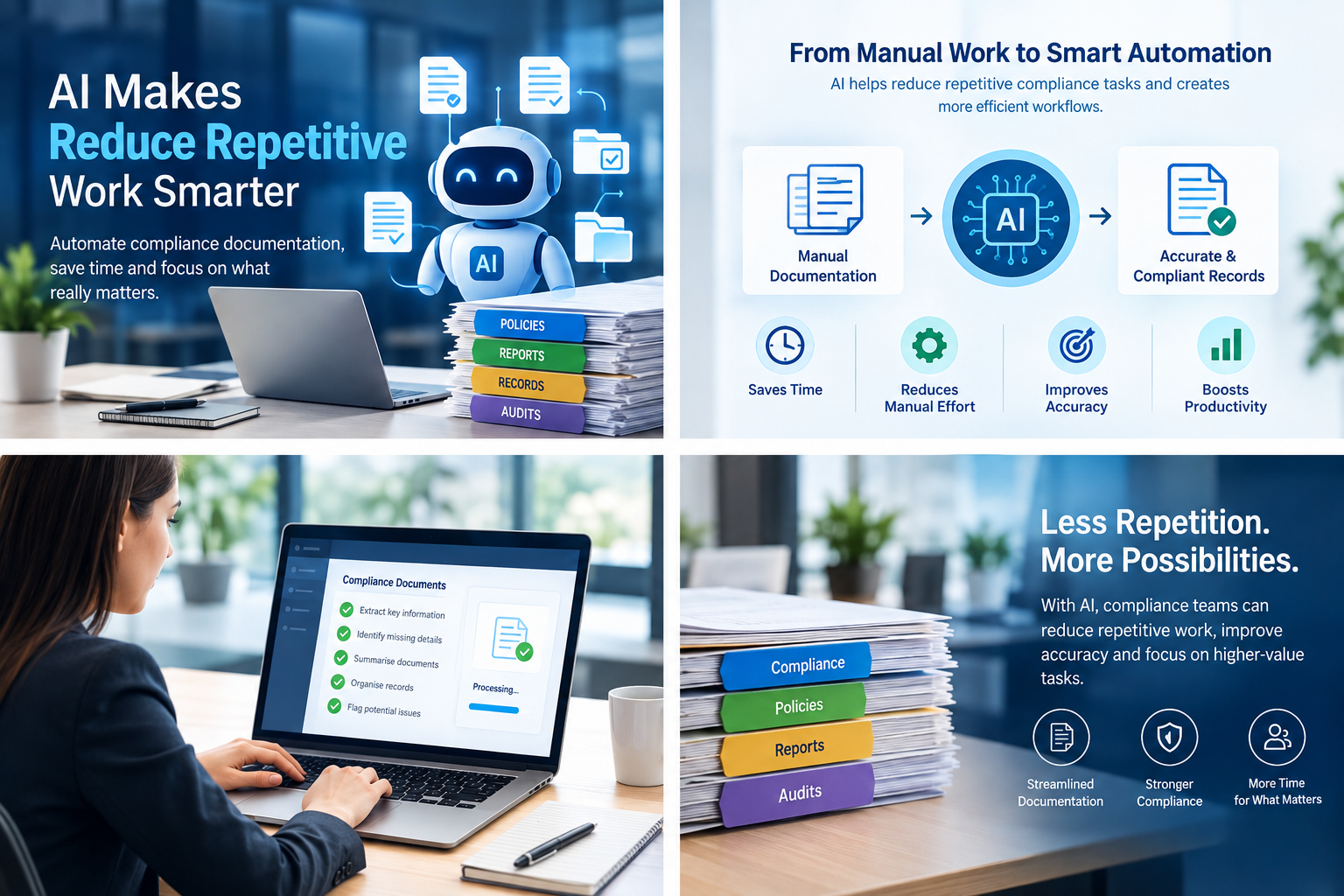
Reduce Repetitive Work Smarter
Introduction
Businesses handle a growing amount of compliance documentation every day. From preparing reports and updating records to reviewing policies and maintaining audit trails, these responsibilities can consume valuable employee time. This is where artificial intelligence is creating meaningful changes. Modern AI systems can Reduce Repetitive administrative work by automating routine activities while helping teams maintain greater consistency.
Instead of spending hours copying information between documents, checking the same fields, or searching through large collections of records, employees can use intelligent tools to support these processes. The result is a workflow that gives professionals more time to focus on decisions, analysis, and responsibilities that require human judgment.
How AI Helps Reduce Repetitive Compliance Work
Compliance teams often work with structured information that follows established patterns. This makes many documentation activities suitable for automation. AI can identify information, organise records, generate drafts, and highlight missing details.
For example, an AI-powered system may review a collection of documents and identify important dates, names, policy references, or required fields. Rather than manually searching through every file, an employee can review the information identified by the system.
The technology does not necessarily remove people from the process. Instead, it can act as an assistant that handles routine preparation while employees remain responsible for reviewing important information.
Reduce Repetitive Documentation Tasks
Documentation is one of the areas where automation can deliver practical benefits. Employees may repeatedly perform similar actions across different forms, reports, policies, and records.
AI can assist with activities such as:
- Extracting information from documents
- Creating initial report drafts
- Classifying files
- Identifying missing information
- Summarising lengthy records
- Organising compliance information
- Comparing documents for changes
These capabilities can make everyday workflows less time-consuming without changing the underlying compliance requirements.
AI Makes Compliance Documentation More Efficient
Traditional documentation processes often depend heavily on manual data entry. Even when employees follow established procedures, repetitive work can introduce delays and inconsistencies.
AI can process information quickly and present relevant details in a structured format. For instance, an organisation could use an AI system to examine multiple internal documents and produce a summary for an employee to review.
The employee still needs to verify the output, particularly when documentation has legal, financial, regulatory, or operational consequences. AI therefore works most effectively when combined with appropriate human oversight.
Key Areas Where AI Can Help
Different compliance workflows can benefit from different forms of automation. The following table illustrates common applications:
| Compliance Activity | AI Support | Potential Benefit |
|---|---|---|
| Document review | Information extraction | Faster initial review |
| Report preparation | Draft generation | Less manual writing |
| Record organisation | Classification | Easier document management |
| Policy comparison | Difference detection | Faster identification of changes |
| Data checking | Pattern recognition | More consistent reviews |
| Audit preparation | Record summarisation | Faster information gathering |
These applications demonstrate why organisations are increasingly exploring AI for administrative workflows.
Reduce Repetitive Data Entry
Data entry is another area where employees can spend significant amounts of time. Information may need to be transferred from emails, forms, spreadsheets, databases, and documents into another system.
AI-powered extraction tools can help identify relevant information and prepare it for structured systems. Optical character recognition, natural language processing, and machine learning can work together to interpret different types of content.
Automation can be particularly useful when the same categories of information appear repeatedly. Employees can then concentrate on checking the extracted information rather than entering every field manually.
Smarter Document Search
Finding a specific piece of information inside a large document library can also be time-consuming. Conventional searches often depend on exact keywords, while AI-based search can understand context and related concepts.
An employee might ask a system to locate documents concerning a particular policy requirement or reporting period. The system can potentially identify relevant material across multiple files and summarise the findings.
This can make compliance research more accessible, especially for organisations with extensive documentation archives.
AI and Compliance Accuracy
Efficiency is only one consideration when introducing AI into documentation workflows. Accuracy is equally important.
AI-generated content should be reviewed before it becomes part of an official compliance record. Systems can misunderstand context, overlook exceptions, or generate information that appears plausible but requires verification.
A strong workflow therefore combines automated processing with human review. AI handles suitable routine activities, while qualified employees validate important information.
This approach can help organisations gain the productivity benefits of automation without treating AI output as automatically correct.
Reduce Repetitive Reviews With Intelligent Workflows
Compliance teams may repeatedly check documents against similar requirements. AI can assist by comparing records with predefined criteria and identifying areas that deserve attention.
For example, a system could flag a missing field, identify an unusual entry, or highlight a difference between two versions of a policy.
The employee can then investigate the flagged item rather than manually reviewing every part of every document. This can shift human effort toward exceptions and higher-value decisions.
Better Use of Employee Time
One of the most important advantages of automation is the ability to redirect employee attention.
When professionals spend less time on routine documentation, they may have more opportunity to work on activities such as:
- Policy interpretation
- Risk analysis
- Process improvement
- Internal communication
- Compliance planning
- Training and education
- Strategic decision-making
The goal is not simply to make employees work faster. It is to create workflows where human expertise is applied where it provides the most value.
AI Makes Compliance Processes More Scalable
As organisations grow, their documentation requirements often grow as well. A manual process that works for a small team may become difficult to manage when document volumes increase.
AI can support scalability by processing large amounts of information more efficiently. An organisation can use automated systems to assist with document classification, information extraction, and preliminary analysis.
However, scalability also requires strong governance. Organisations should establish clear rules for data access, review procedures, security, and accountability before expanding AI across compliance operations.
Security and Privacy Considerations
Compliance documents can contain sensitive business information. Introducing AI therefore requires careful consideration of privacy and security.
Organisations should understand how an AI solution stores, processes, and protects information. Access controls should ensure that employees only interact with documents they are authorised to view.
Companies should also establish policies covering acceptable AI usage, data retention, human review, and the handling of confidential information.
Technology can improve efficiency, but security practices must remain an important part of the implementation process.
Measuring the Impact of AI
Businesses should evaluate AI adoption using measurable indicators rather than relying only on general impressions.
Useful measurements can include document processing time, review workloads, error rates, turnaround times, and employee productivity.
| Measurement | Before Automation | After Automation |
|---|---|---|
| Document processing time | Manually tracked | Compare average duration |
| Data entry workload | Count manual tasks | Measure automated tasks |
| Review time | Track employee hours | Compare review hours |
| Error identification | Manual checks | Compare flagged issues |
| Reporting speed | Measure turnaround | Compare completion time |
These measurements can help organisations understand whether an AI workflow is delivering practical value.
Reduce Repetitive Work Without Removing Human Oversight
Automation works best when companies establish a clear division between machine-supported activities and human responsibilities.
AI can prepare information, identify patterns, organise records, and create preliminary content. Employees can then verify important details and make decisions based on their professional knowledge.
This human-in-the-loop model is especially useful for compliance because regulations and internal policies can involve context that automated systems may not fully understand.
The Future of AI in Compliance Documentation
AI technology is likely to become increasingly integrated into business documentation. Future systems may offer more advanced document analysis, improved contextual search, automated workflow management, and better connections between compliance platforms.
As these capabilities develop, organisations will need to focus not only on technological adoption but also on responsible implementation. Clear policies, employee training, data governance, and ongoing monitoring will remain essential.
Companies that approach automation thoughtfully can create documentation processes that are faster and more organised while preserving appropriate human oversight.
Conclusion
AI is changing how organisations approach compliance documentation by supporting tasks that traditionally require significant amounts of manual effort. From document analysis and data extraction to intelligent search and workflow automation, these tools can help businesses Reduce Repetitive work and make better use of employee time.
The most effective approach is not to depend entirely on automation. Instead, businesses can combine AI capabilities with human expertise, review, and accountability. With appropriate safeguards, AI can become a practical part of modern compliance operations, helping teams manage growing documentation demands while focusing their attention on more meaningful responsibilities.
Key Takeaways
- AI can automate many routine documentation activities.
- Intelligent extraction can reduce manual data entry.
- AI-assisted search can make large document libraries easier to navigate.
- Human review remains important for compliance-related information.
- Security and privacy should be considered before implementation.
- Organisations can measure automation through time, workload, and accuracy metrics.
- Effective AI adoption combines technology with human expertise.
editor's pick
latest video

news via inbox
Nulla turp dis cursus. Integer liberos euismod pretium faucibua



[…] Traditional approach […]
[…] Strengthen Access Control and Building Security […]