
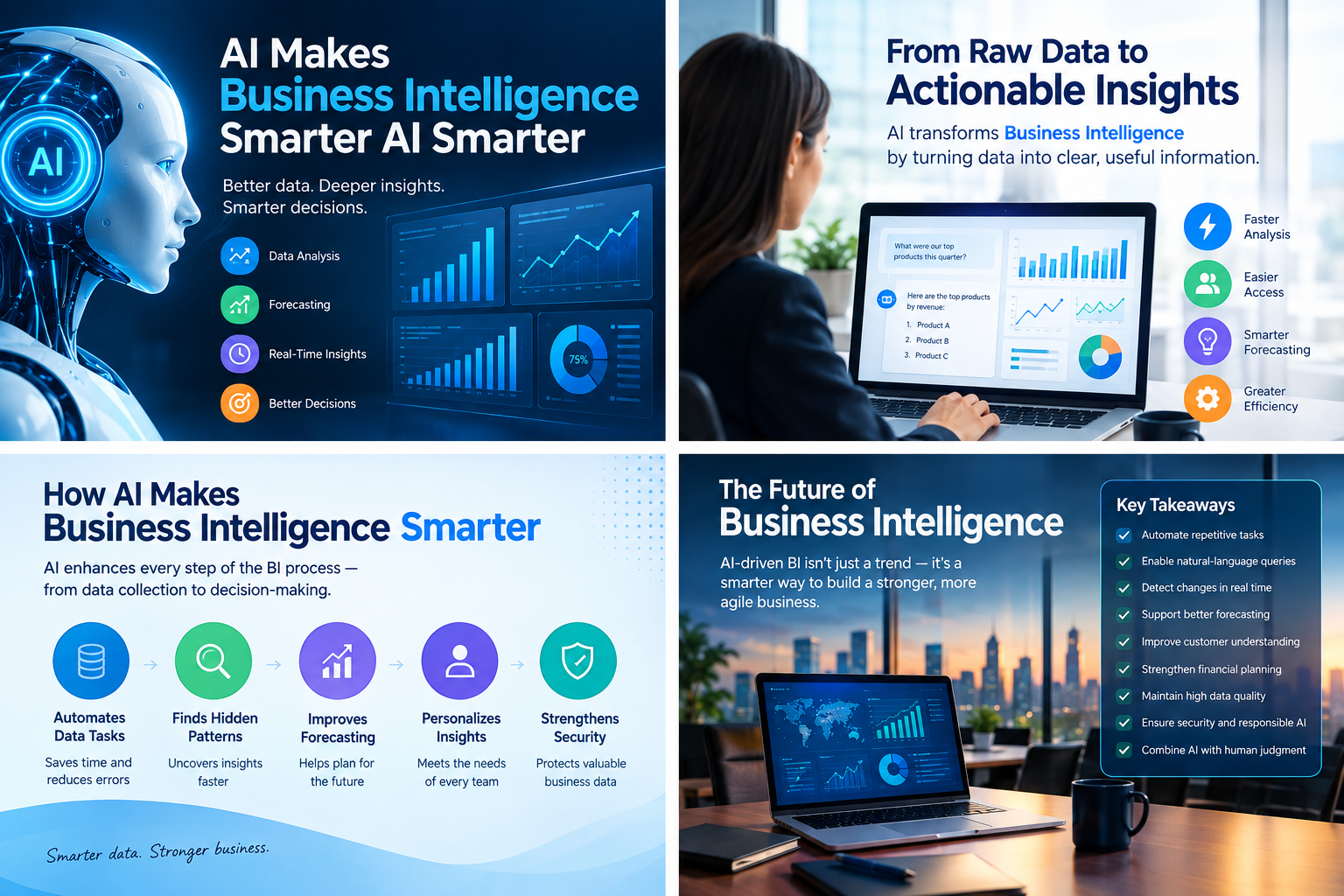
AI Makes Business Intelligence Smarter
Why Business Intelligence Is Changing With AI
Traditional analytics tools are useful, but they often depend on predefined dashboards and reports. Employees usually need to know which data to examine and what questions to ask. AI introduces a more flexible approach.
Modern AI systems can analyze large datasets, identify unusual changes, summarize information, and help users explore trends using natural language. Instead of spending hours searching through spreadsheets, a manager may be able to ask a straightforward question and receive an understandable summary.
This does not mean that AI replaces human decision-making. Rather, it can reduce repetitive analytical work and give employees more time to focus on strategy, planning, and problem-solving.
Business Intelligence Becomes More Accessible
One of the most significant benefits of AI is accessibility. Data analysis has traditionally been associated with analysts, data scientists, and technical teams. AI-powered platforms can make insights easier for sales managers, marketing teams, financial departments, and business owners to access.
For example, a sales manager could ask why revenue changed during a particular month. An AI-enabled platform might examine sales volume, product categories, customer segments, and regional performance before presenting the most relevant patterns.
This approach allows nontechnical users to interact with data more naturally.
How AI Improves Business Intelligence
AI can improve analytics in several important ways. Automation is one of the biggest advantages. Routine tasks such as data preparation, report generation, trend detection, and anomaly identification can often be streamlined.
The following table illustrates how AI can enhance common analytical activities:
| Traditional Process | AI-Enhanced Approach | Potential Benefit |
|---|---|---|
| Manual data collection | Automated data integration | Less repetitive work |
| Static reports | Dynamic insights | Faster understanding |
| Spreadsheet analysis | AI-assisted analysis | Easier pattern detection |
| Manual anomaly checks | Automated alerts | Earlier issue detection |
| Fixed dashboards | Natural-language queries | More flexible exploration |
These capabilities can make analytics more responsive. Instead of waiting for a scheduled report, teams may receive relevant information when an important change occurs.
Smarter Forecasting and Trend Analysis
Predicting future business conditions has always been challenging. Companies need to consider historical performance, customer behaviour, market changes, seasonal patterns, and other variables.
AI can analyze these factors simultaneously and identify relationships that might be difficult to notice manually. When connected with historical company data, AI-powered analytical systems can support forecasting for areas such as sales, inventory, staffing, and demand.
For instance, a retailer could examine previous purchasing patterns to identify periods when demand typically increases. A manufacturer could analyze production information to detect potential capacity issues. A subscription business might examine customer activity to identify changes in engagement.
Forecasting is still uncertain, and AI-generated predictions should be reviewed alongside human expertise. However, faster access to relevant patterns can make planning more informed.
Business Intelligence and Real-Time Decisions
Speed matters in modern business. A report that arrives weeks after an event may not provide much value when a company needs to respond immediately.
AI can help organizations monitor information continuously and highlight meaningful changes. A sudden decline in sales, unexpected increase in website traffic, or unusual operational cost could trigger an alert for further investigation.
Real-time analytics can be particularly useful for businesses with rapidly changing customer demand. Instead of relying exclusively on historical monthly reports, managers can monitor current indicators and respond as circumstances develop.
This creates a more proactive approach to decision-making.
Improving Customer Understanding
Customers generate enormous amounts of information through purchases, websites, applications, surveys, support interactions, and other channels. Understanding that information can help companies create better experiences.
AI can organize customer-related data and identify recurring patterns. Businesses may use these insights to understand purchasing behaviour, identify frequently requested products, or recognize changes in customer engagement.
For example, an online retailer could analyze browsing and purchasing activity to discover which product categories attract the most interest. A service company might examine support conversations to identify recurring customer concerns.
The goal is not simply to collect more information. The real value comes from transforming information into useful knowledge.
Business Intelligence for Financial Planning
Financial teams can also benefit from AI-assisted analytics. Organizations regularly monitor revenue, expenses, cash flow, budgets, and profitability. Reviewing all of these figures manually can be time-consuming.
AI can help identify unusual transactions, compare current performance with historical figures, and highlight significant changes. It can also assist with financial reporting by organizing information into understandable summaries.
For example, consider a simple comparison:
| Financial Area | Traditional Review | AI-Assisted Review |
|---|---|---|
| Expenses | Manual comparison | Automated variance detection |
| Revenue | Periodic reporting | Continuous monitoring |
| Cash flow | Spreadsheet analysis | Pattern-based insights |
| Budgeting | Historical estimates | Data-supported forecasting |
| Performance | Static summaries | Interactive analysis |
Human financial professionals remain essential because financial decisions require context, judgment, and accountability. AI works best as an analytical assistant rather than an unquestioned authority.
AI Helps Reduce Analytical Workloads
Employees often spend considerable time preparing information before they can actually analyze it. Data may exist across spreadsheets, databases, customer platforms, financial systems, and operational software.
AI-enabled tools can help automate parts of this preparation process. They may classify information, identify inconsistencies, summarize datasets, and assist with repetitive reporting tasks.
Reducing administrative work can allow employees to concentrate on higher-value activities. Analysts, for example, may spend less time formatting recurring reports and more time investigating why a particular trend is occurring.
This shift can improve productivity while also making analytical resources available to more departments.
Business Intelligence and Data Quality
AI cannot produce reliable insights from unreliable information. Data quality therefore remains a fundamental consideration.
Organizations should ensure that information is accurate, current, properly structured, and collected responsibly. Duplicate records, missing values, inconsistent definitions, and outdated information can affect analytical results.
A strong data foundation should include clear ownership, appropriate access controls, regular quality checks, and consistent definitions for important business metrics.
Companies should also understand where AI-generated insights originate. Transparency helps employees verify important findings rather than accepting automated recommendations without review.
Security and Responsible AI
As organizations introduce AI into analytical workflows, security becomes increasingly important. Business information can contain financial records, customer information, operational details, and confidential company data.
Organizations should establish appropriate policies for data access and AI usage. Employees need to understand which information can be entered into AI systems and which information requires additional protection.
Responsible implementation also involves monitoring AI outputs for errors and unexpected results. AI systems can identify valuable patterns, but they can also misunderstand context or produce inaccurate conclusions.
Human oversight remains an important part of responsible implementation.
The Future of Business Intelligence
The future of analytics is likely to become increasingly conversational and automated. Instead of navigating numerous dashboards, users may interact with data by asking questions in ordinary language.
Imagine a manager asking, “Which product categories experienced the largest change this quarter?” The system could analyze relevant information and present a concise explanation, supporting charts, and additional questions for exploration.
As AI capabilities develop, analytical platforms may also become more personalized. Different departments could receive insights based on their responsibilities, objectives, and approved data access.
This could make business analytics more practical for organizations of different sizes, from growing companies to large enterprises.
Key Takeaways
The combination of AI and modern analytics is changing how companies work with information. The most important points include:
- AI can automate repetitive analytical tasks.
- Natural-language interaction can make data easier to explore.
- Automated alerts can help businesses identify important changes sooner.
- Forecasting tools can support planning and resource management.
- Customer data can provide deeper insight into behaviour and preferences.
- Financial teams can use AI to identify patterns and unusual changes.
- Data quality remains essential for trustworthy results.
- Security and responsible AI practices should be part of implementation.
- Human judgment remains important when interpreting AI-generated insights.
Conclusion
AI is making Business Intelligence more accessible, responsive, and useful for modern organizations. By automating repetitive processes, identifying patterns, supporting forecasting, and making data easier to explore, AI can help companies turn information into practical insights.
However, successful implementation requires more than simply adding an AI feature to an existing analytics platform. Businesses need reliable data, strong security practices, clear governance, and employees who understand how to evaluate automated insights.
The strongest approach combines machine intelligence with human experience. AI can process information quickly and uncover patterns at scale, while people provide context, creativity, responsibility, and strategic judgment. Together, these capabilities can create a more flexible approach to business decision-making and help organizations respond more effectively to an increasingly data-driven marketplace.
editor's pick
latest video

news via inbox
Nulla turp dis cursus. Integer liberos euismod pretium faucibua



[…] Business application […]
[…] Do Not Ignore Warning Lights […]