
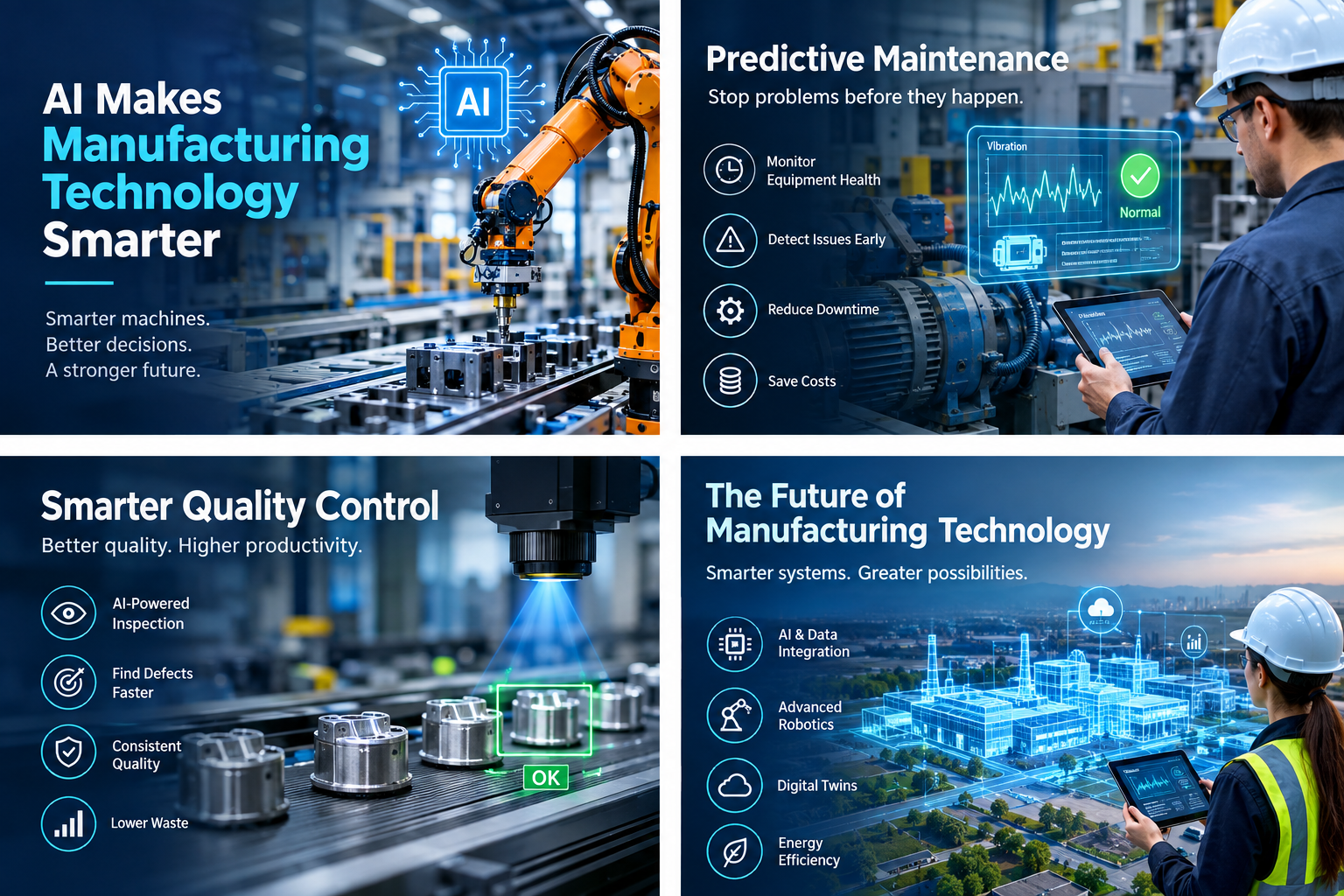
Manufacturing Technology Smarter
How AI Is Transforming Manufacturing Technology
Modern factories generate enormous amounts of data every day. Machines record temperatures, operating speeds, production volumes, energy consumption, maintenance information, and quality measurements. Traditionally, much of this information required manual analysis. AI can process large datasets quickly and identify patterns that may be difficult for people to notice.
This development is making Manufacturing Technology more proactive. Instead of simply responding to problems after they occur, businesses can use intelligent systems to identify warning signs earlier. This can help production teams make better-informed decisions and keep operations running smoothly.
AI does not necessarily replace existing equipment. In many cases, it works alongside machinery, sensors, enterprise software, and human workers. This combination allows manufacturers to build smarter systems without completely businesses replacing their existing infrastructure.
AI-Powered Predictive Maintenance
Equipment failure can interrupt production and create expensive repair requirements. Predictive maintenance uses AI to examine information collected from machines and identify unusual patterns that could indicate potential problems.
For example, an industrial motor may gradually show changes in vibration, temperature, or power consumption. An AI system can these changes and alert maintenance teams before the issue becomes a major breakdown.
This approach can help companies schedule maintenance more effectively. Instead of servicing every machine according to a fixed timetable, businesses can consider the actual condition and usage of individual equipment.
The result is a more responsive approach to maintenance and another important way AI is strengthening Manufacturing Technology.
Smarter Quality Control With AI
Quality control is another area where artificial intelligence can make a significant difference. Computer vision systems can inspect products as they move through production lines, looking for defects, inconsistencies, or manufacturing errors.
Human inspection remains valuable, but automated visual systems can examine large numbers of products consistently. AI models can be trained to particular patterns and distinguish acceptable products from items that may require additional inspection.
This can be especially useful in industries where precision matters, including electronics, automotive manufacturing, pharmaceuticals, and consumer products.
When integrated into modern Manufacturing Technology, AI-powered inspection can provide faster feedback to production teams. If a recurring defect appears, managers can investigate the underlying production process rather than discovering the problem much later.
Manufacturing Technology and Production Planning
Production planning involves balancing orders, resources, workers, machinery, inventory, and delivery schedules. Even a small disruption can affect several parts of the supply chain.
AI can analyse historical production information and current operational data to support more informed planning. It can identify demand patterns, highlight possible capacity problems, and help businesses consider different scheduling scenarios.
The following table illustrates several common applications:
| AI Application | Manufacturing Benefit | Business Impact |
|---|---|---|
| Predictive maintenance | Earlier fault detection | Less unplanned downtime |
| Computer vision | Automated inspection | More consistent quality checks |
| Demand forecasting | Better production planning | Improved inventory management |
| Process optimisation | Identifies inefficiencies | Greater operational efficiency |
| Robotics | Automated repetitive tasks | Increased production flexibility |
| Energy analytics | Tracks consumption patterns | Potential energy savings |
These applications demonstrate how AI can connect different parts of a manufacturing operation rather than functioning as a single isolated tool.
AI Is Improving Manufacturing Efficiency
Efficiency is one of the main reasons manufacturers are investing in artificial intelligence. Production environments often contain processes that consume unnecessary time, energy, or materials.
AI can examine operational information and identify areas where improvements may be possible. For instance, an intelligent system might detect that a particular production sequence consistently creates delays. Managers can then investigate the process and consider alternative approaches.
AI can also support energy management. Manufacturing facilities use substantial amounts of electricity, heating, cooling, and other resources. Intelligent monitoring systems can analyse consumption patterns and help businesses identify opportunities to use resources more efficiently.
This makes Manufacturing Technology increasingly connected to broader business goals such as cost management, sustainability, and operational resilience.
The Role of Robotics and Automation
Robotics has been part of industrial manufacturing for decades, but AI is giving automated machines greater flexibility. Traditional robots generally perform carefully programmed tasks. AI-enabled systems can potentially respond to changing conditions and use data to improve how tasks are performed.
Collaborative robots, often called , can also work in environments designed around human-machine cooperation. They can handle repetitive or physically demanding tasks while workers focus on activities that require judgement, communication, or problem-solving.
The combination of robotics, sensors, machine learning, and connected software is creating a new generation of Manufacturing Technology in which automated systems can respond more intelligently to production conditions.
Digital Twins and Intelligent Manufacturing
Digital twins are virtual representations of physical products, machines, or production environments. They can use information from real-world equipment to represent how a system is operating.
AI can make these digital models more useful by analysing data and identifying patterns. Manufacturers can use digital simulations to explore potential changes before applying them to a physical production environment.
For example, a company could model a proposed production adjustment and examine possible effects on capacity, equipment usage, or workflow. While digital twins require appropriate data and implementation expertise, they can provide valuable support for complex manufacturing decisions.
Manufacturing Technology and the Human Workforce
The growth of AI does not mean that human expertise becomes irrelevant. In many manufacturing environments, employees remain responsible for supervising systems, interpreting information, solving unusual problems, and making important operational decisions.
Workers may increasingly need digital skills alongside traditional technical knowledge. Understanding data, automation systems, AI-supported tools, and cybersecurity can become increasingly valuable.
Manufacturers that invest in employee training can help their workforce adapt to changing technologies. Rather than viewing AI solely as an automation tool, companies can treat it as technology that gives employees better information and helps them perform their roles more effectively.
Challenges of Adopting AI
Despite its potential, introducing AI into a manufacturing environment is not always straightforward. Companies may have older equipment that was not designed to communicate with modern software. Integrating new systems with existing infrastructure can require significant planning.
Data quality is another important consideration. AI systems depend on useful information. Incomplete, inaccurate, or inconsistent data can reduce the value of an AI application.
Cybersecurity must also receive attention. As factories become more connected, protecting industrial systems and business information becomes increasingly important.
Companies therefore need to consider technology, security, employee training, data management, and long-term maintenance when implementing Manufacturing Technology solutions.
The Future of Manufacturing Technology
The next stage of industrial development is likely to involve even greater connectivity between machines, software, workers, and supply chains. AI can become a central layer that helps different systems communicate and interpret information.
Manufacturers may increasingly use AI to support real-time decision-making, adaptive production, automated inspection, inventory planning, and energy management.
However, successful adoption will depend on more than simply purchasing new software. Businesses will need clear objectives and reliable data, while employees will need the skills to work effectively with intelligent systems.
The companies developing these capabilities are creating manufacturing environments that can respond more quickly to changing market conditions and operational requirements.
Key Takeaways
AI is making modern factories more connected, data-driven, and adaptable. Predictive maintenance can help identify equipment problems earlier, while computer vision can support faster quality inspections. Intelligent planning tools can help manufacturers manage production schedules, inventory, and resources.
Robotics and automation are also evolving as AI gives machines greater ability to respond to changing environments. At the same time, human workers continue to play an essential role in supervision, problem-solving, and decision-making.
The most successful approach is likely to be one that combines intelligent technology with human expertise. By introducing AI strategically, manufacturers can build more responsive operations while preparing their businesses for the changing demands of the industrial sector.
Conclusion
AI is moving manufacturing beyond simple automation toward systems that can analyse information, recognise patterns, and support better decisions. From maintenance and quality control to production planning and energy management, artificial intelligence is influencing nearly every stage of industrial operations.
As businesses in the US and UK continue investing in digital transformation, Manufacturing Technology will remain an important part of the modern industrial landscape. Companies that combine reliable data, skilled employees, appropriate automation, and responsible AI implementation can create production environments that are more flexible and prepared for future challenges.
The goal is not simply to make factories more automated. It is to make them more informed, adaptable, and capable of responding intelligently to the needs of modern manufacturing.
editor's pick
latest video

news via inbox
Nulla turp dis cursus. Integer liberos euismod pretium faucibua


[…] future flexibility, excessive investment can tie up capital that could be used for vehicles, route optimisation, maintenance, or other business […]